History of PHP

Introduction to PHP — What is PHP? — History of PHP — Server-side vs client-side — Installing XAMPP / WAMP / LAMP — First PHP script (hello.php) Basic Syntax — PHP tags () — Echo vs print — Comments — Case sensitivity Variables and Data Types — Declaring variables — Data types — Type juggling and casting — Constants Operators — Arithmetic — Assignment — Comparison — Logical — Increment/Decrement — Ternary operator Control Structures — if, else, elseif — switch — while, do-while — for and foreach — break and continue Functions — Declaring and calling functions — Parameters and default values — Return values — Variable scope — Built-in functions Arrays — Indexed arrays — Associative arrays — Multidimensional arrays — Array functions Strings and String Functions — String interpolation — Heredoc and Nowdoc — Common string functions Forms and User Input — GET vs POST — Validating form input — Sanitizing input — $_GET, $_POST, $_REQUEST, $_SERVER File Handling — Opening and reading files — Writing to files — File upload handling — File permissions and errors Cookies and Sessions — Setting and getting cookies — Starting sessions — Storing user data — Session vs cookie differences Error and Exception Handling — Error types — try-catch blocks — Custom exception classes — Error reporting Working with Dates and Time — date() and time() functions — Timezones — strtotime() and DateTime PHP and HTML Integration — Embedding PHP in HTML — Separating logic and presentation — Using includes Object-Oriented Programming (OOP) — Classes and objects — Constructors and destructors — Inheritance and polymorphism — Interfaces and traits — Magic methods Namespaces and Autoloading — Why use namespaces? — Declaring and using namespaces — PSR-4 autoloading — Composer autoloading Working with MySQL (MySQLi / PDO) — Connecting to database — CRUD operations — Prepared statements — Fetching data — PDO vs MySQLi Security in PHP — SQL Injection prevention — Cross-site scripting (XSS) — Cross-site request forgery (CSRF) — Password hashing File Upload and Image Handling — Handling file uploads — Validating files — Storing and renaming files — Image resizing Sessions and Authentication — Login system — Session security — Access control — Logout functionality Composer and Dependency Management — What is Composer? — Installing Composer — Using packages — Autoloading REST APIs in PHP — Creating APIs — JSON encoding/decoding — API authentication MVC Pattern — Understanding MVC — Building a mini MVC framework — Routing and controllers — Views and templating PHP Frameworks Overview — Laravel — CodeIgniter — Symfony — When and why to use Project Ideas — Simple blog system — Contact form with email — To-Do list with MySQL — User registration and login — File manager/gallery app — REST API with token login

History of PHP

Understand History of PHP in PHP with practical examples and clear syntax.

History of PHP

PHP has a rich history spanning over two decades. It began as a simple tool for personal website tracking and evolved into one of the most widely-used server-side scripting languages on the web.

  • 1994: Rasmus Lerdorf created PHP as a set of CGI binaries written in C to track visits to his online resume. It was originally called Personal Home Page Tools.
  • 1995: PHP was released to the public as PHP/FI (Forms Interpreter), enabling developers to build dynamic web applications.
  • 1997: PHP 3 was released, marking the birth of PHP as we know it. Zeev Suraski and Andi Gutmans rewrote the parser and introduced the name PHP: Hypertext Preprocessor.
  • 2000: PHP 4 introduced the Zend Engine, providing better performance and modularity.
  • 2004: PHP 5 added robust Object-Oriented Programming (OOP) support, PDO (PHP Data Objects), and better XML handling.
  • 2015: PHP 7 was a major leap in speed and performance, introducing scalar type declarations, return type declarations, and the null coalescing operator.
  • 2020: PHP 8 introduced the JIT (Just-In-Time) compiler, union types, and other modern programming features.
  • Today: PHP powers over 75% of websites with server-side code, including platforms like WordPress, Magento, and Laravel.
Full Stack Development Course

🚀 Master Top Web & App Frameworks

Explore structured tutorials for AngularJS, React, Laravel, Flutter, PHP, SQL, and more.

📘 Introduction to AngularJS

Introduction to AngularJS overview

📘 Introduction to Laravel

Learn Introduction to Laravel in Laravel with real-world examples and step-by-step guide.

📘 Introduction to CodeIgniter

An introduction to Introduction to CodeIgniter in CodeIgniter with examples.

📘 Introduction to React

Quick overview and guide to Introduction to React in React JS.

📘 Introduction to Flutter

An easy-to-follow tutorial on Introduction to Flutter in Flutter mobile app development.

📘 Introduction to Kotlin

Learn Introduction to Kotlin in Kotlin programming with examples for Android or backend apps.

📘 Introduction to PHP

Understand Introduction to PHP in PHP with practical examples and clear syntax.

📘 Introduction to SQL

Understand Introduction to SQL in SQL for effective database querying and management.

📘 Introduction to Bootstrap 5

Understand Introduction to Bootstrap 5 in Bootstrap 5 for responsive web design using pre-built components.

📘 Introduction to HTML

Understand Introduction to HTML in HTML to create structured, semantic, and accessible web content.

📘 Introduction to CSS

Explore Introduction to CSS in CSS to enhance web design using styling properties and layout techniques.

📘 Introduction to JavaScript

Understand Introduction to JavaScript in JavaScript to build dynamic and interactive web experiences.

📘 Introduction to Node.js

Explore Introduction to Node.js in NodeJS for backend development using JavaScript and non-blocking architecture.

📘 Introduction to AJAX

Understand Introduction to AJAX in AJAX to update web pages without full reloads using asynchronous JavaScript and XML.

📘 Introduction to jQuery

Learn Introduction to jQuery in jQuery to write less and do more with simplified JavaScript operations and cross-brow...

📰 Latest Blog Posts

Insights, tutorials, and tech stories from our experts.

Transform Your Passion into a Web Development Career

Do you love tech? Let’s turn it into a profession with full stack development.

Not Just Coding – Career-Focused Full Stack Training

We don’t just teach code—we teach how to get jobs with it.

Learn, Code, Build, Get Hired – Full Stack Program

A step-by-step path to go from beginner to hired developer.

BCA/MCA/B.Tech? Start Building Real Websites Now!

Already pursuing IT education? Now build real websites with us!

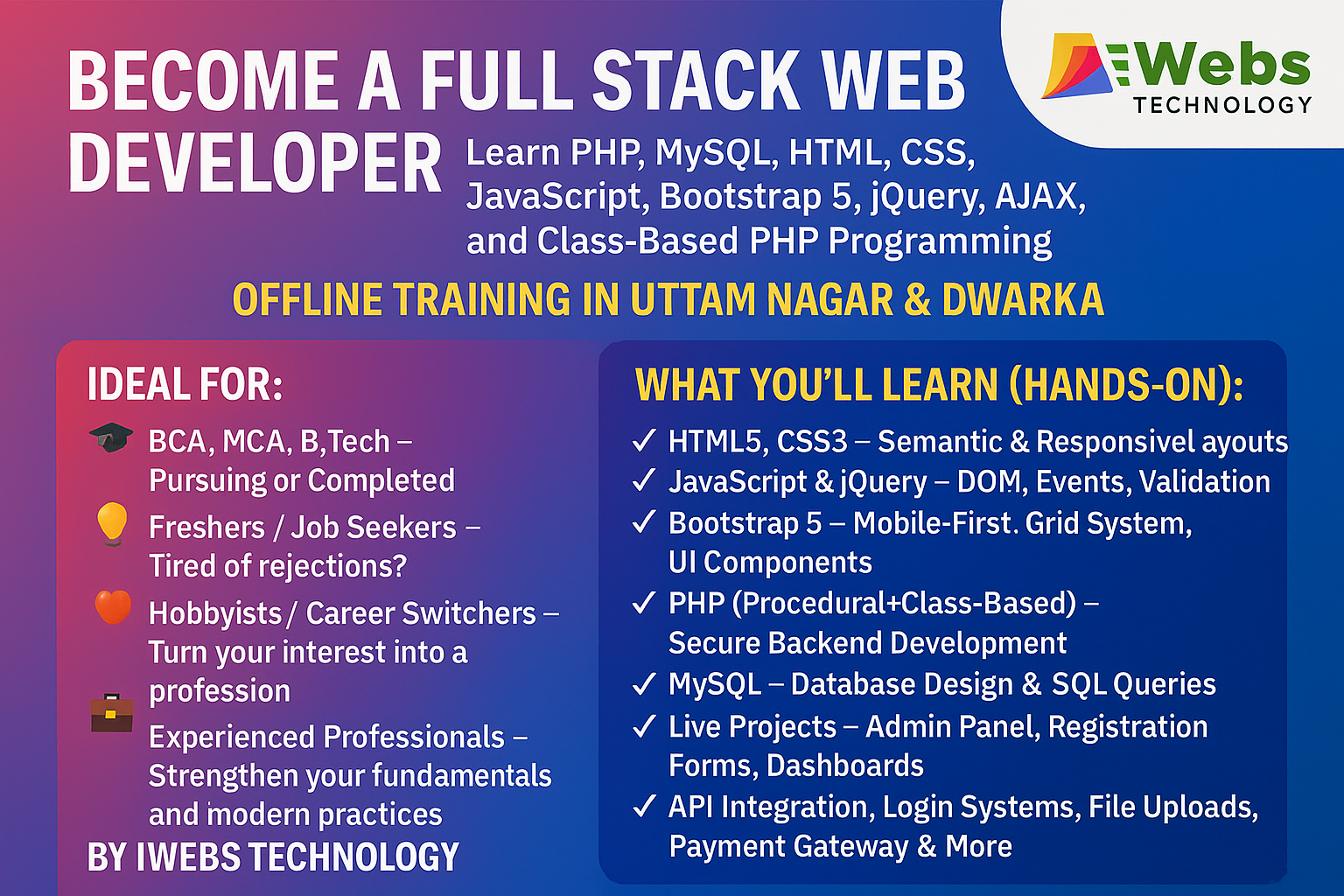
Offline Full Stack Training in Dwarka & Uttam Nagar – Limited Seats!

Join our offline batch in Dwarka or Uttam Nagar and learn full stack development practically.

Struggling in Interviews? Build Skills That Get You Hired!

Facing rejections in job interviews? Build the right skills and project experience.