What is SQL?

Introduction to SQL — What is SQL? — History and standards (SQL-92, SQL:2011) — Popular RDBMS: MySQL, PostgreSQL, SQLite, SQL Server — SQL syntax and structure Database Basics — What is a database? — Tables, rows, columns — Primary key and foreign key — Relational model overview Creating and Managing Databases — CREATE DATABASE — USE, DROP DATABASE — Database naming conventions Creating and Managing Tables — CREATE TABLE syntax — Data types (INT, VARCHAR, DATE, etc.) — Constraints (NOT NULL, UNIQUE, DEFAULT) — DROP and ALTER TABLE Inserting Data — INSERT INTO syntax — Inserting single and multiple rows — Using DEFAULT values Querying Data (SELECT) — SELECT basics — Filtering with WHERE — Sorting with ORDER BY — DISTINCT keyword — LIMIT and OFFSET Filtering Data — Comparison operators (=, <>, >, etc.) — Logical operators (AND, OR, NOT) — BETWEEN, IN, LIKE — IS NULL / IS NOT NULL Updating and Deleting Data — UPDATE syntax — DELETE syntax — WHERE clause best practices — TRUNCATE vs DELETE Joins in SQL — INNER JOIN — LEFT JOIN — RIGHT JOIN — FULL OUTER JOIN — Self join and cross join Aggregate Functions — COUNT(), SUM(), AVG(), MIN(), MAX() — GROUP BY and HAVING — Filtering grouped data Subqueries — Subqueries in SELECT, WHERE, FROM — Correlated vs non-correlated subqueries Set Operations — UNION vs UNION ALL — INTERSECT and EXCEPT (if supported) Indexes — What is an index? — CREATE INDEX syntax — Unique index — Performance considerations Constraints and Keys — PRIMARY KEY — FOREIGN KEY — CHECK, DEFAULT — ON DELETE / ON UPDATE CASCADE Views — CREATE VIEW syntax — Updating data through views — Dropping views Stored Procedures — What is a stored procedure? — CREATE PROCEDURE — IN, OUT, INOUT parameters — Calling procedures Functions — User-defined functions (UDFs) — Differences from procedures — RETURN values and syntax Triggers — CREATE TRIGGER syntax — BEFORE / AFTER INSERT, UPDATE, DELETE — Use cases and examples Transactions and ACID — BEGIN, COMMIT, ROLLBACK — SAVEPOINT — Understanding ACID properties User and Permission Management — Creating users — GRANT and REVOKE privileges — Roles and security best practices Normalization and Database Design — 1NF, 2NF, 3NF — Denormalization — Designing efficient schemas Working with Dates and Time — DATE, TIME, DATETIME — DATE functions (NOW(), CURDATE(), DATEDIFF()) Common Built-in Functions — String functions (CONCAT, SUBSTRING, REPLACE) — Math functions (ROUND, FLOOR, CEIL) — Date functions (NOW, DATE_ADD, etc.) Performance Tuning — Query optimization — Using EXPLAIN — Reducing slow queries Real-World Projects — Student/course database — E-commerce schema — Blog or CMS backend — Library/book management system

What is SQL?

Understand What is SQL? in SQL for effective database querying and management.

What is SQL?

SQL (Structured Query Language) is a standard programming language used for managing and manipulating relational databases. It allows users to store, retrieve, update, and delete data efficiently.

SQL is used in almost every relational database system including MySQL, PostgreSQL, Oracle, Microsoft SQL Server, and SQLite.

History of SQL

  • Developed by IBM in the early 1970s as SEQUEL (Structured English Query Language).
  • Renamed to SQL and standardized by ANSI (American National Standards Institute) in 1986.
  • Adopted widely in RDBMS systems and continues to evolve.

Key Features of SQL

  • Data Querying: Retrieve data using SELECT statements.
  • Data Manipulation: INSERT, UPDATE, DELETE records.
  • Data Definition: CREATE, ALTER, DROP tables and databases.
  • Data Control: Manage access using GRANT and REVOKE.
  • Transaction Control: COMMIT, ROLLBACK, and SAVEPOINT for database transactions.

Types of SQL Commands

  • DQL (Data Query Language): SELECT
  • DML (Data Manipulation Language): INSERT, UPDATE, DELETE
  • DDL (Data Definition Language): CREATE, ALTER, DROP
  • DCL (Data Control Language): GRANT, REVOKE
  • TCL (Transaction Control Language): COMMIT, ROLLBACK, SAVEPOINT

Basic SQL Syntax

-- Select all rows from a table
SELECT * FROM employees;

-- Insert a new row
INSERT INTO employees (name, age, department) VALUES ('John Doe', 30, 'Sales');

-- Update a row
UPDATE employees SET age = 31 WHERE name = 'John Doe';

-- Delete a row
DELETE FROM employees WHERE name = 'John Doe';

SQL in Real-World Applications

  • Used by websites and apps to interact with user data.
  • Powering backend systems of e-commerce, banking, CRM, and healthcare.
  • Data analysis and reporting in BI tools.
Full Stack Development Course

🚀 Master Top Web & App Frameworks

Explore structured tutorials for AngularJS, React, Laravel, Flutter, PHP, SQL, and more.

📘 Introduction to AngularJS

Introduction to AngularJS overview

📘 Introduction to Laravel

Learn Introduction to Laravel in Laravel with real-world examples and step-by-step guide.

📘 Introduction to CodeIgniter

An introduction to Introduction to CodeIgniter in CodeIgniter with examples.

📘 Introduction to React

Quick overview and guide to Introduction to React in React JS.

📘 Introduction to Flutter

An easy-to-follow tutorial on Introduction to Flutter in Flutter mobile app development.

📘 Introduction to Kotlin

Learn Introduction to Kotlin in Kotlin programming with examples for Android or backend apps.

📘 Introduction to PHP

Understand Introduction to PHP in PHP with practical examples and clear syntax.

📘 Introduction to SQL

Understand Introduction to SQL in SQL for effective database querying and management.

📘 Introduction to Bootstrap 5

Understand Introduction to Bootstrap 5 in Bootstrap 5 for responsive web design using pre-built components.

📘 Introduction to HTML

Understand Introduction to HTML in HTML to create structured, semantic, and accessible web content.

📘 Introduction to CSS

Explore Introduction to CSS in CSS to enhance web design using styling properties and layout techniques.

📘 Introduction to JavaScript

Understand Introduction to JavaScript in JavaScript to build dynamic and interactive web experiences.

📘 Introduction to Node.js

Explore Introduction to Node.js in NodeJS for backend development using JavaScript and non-blocking architecture.

📘 Introduction to AJAX

Understand Introduction to AJAX in AJAX to update web pages without full reloads using asynchronous JavaScript and XML.

📘 Introduction to jQuery

Learn Introduction to jQuery in jQuery to write less and do more with simplified JavaScript operations and cross-brow...

📰 Latest Blog Posts

Insights, tutorials, and tech stories from our experts.

Transform Your Passion into a Web Development Career

Do you love tech? Let’s turn it into a profession with full stack development.

Not Just Coding – Career-Focused Full Stack Training

We don’t just teach code—we teach how to get jobs with it.

Learn, Code, Build, Get Hired – Full Stack Program

A step-by-step path to go from beginner to hired developer.

BCA/MCA/B.Tech? Start Building Real Websites Now!

Already pursuing IT education? Now build real websites with us!

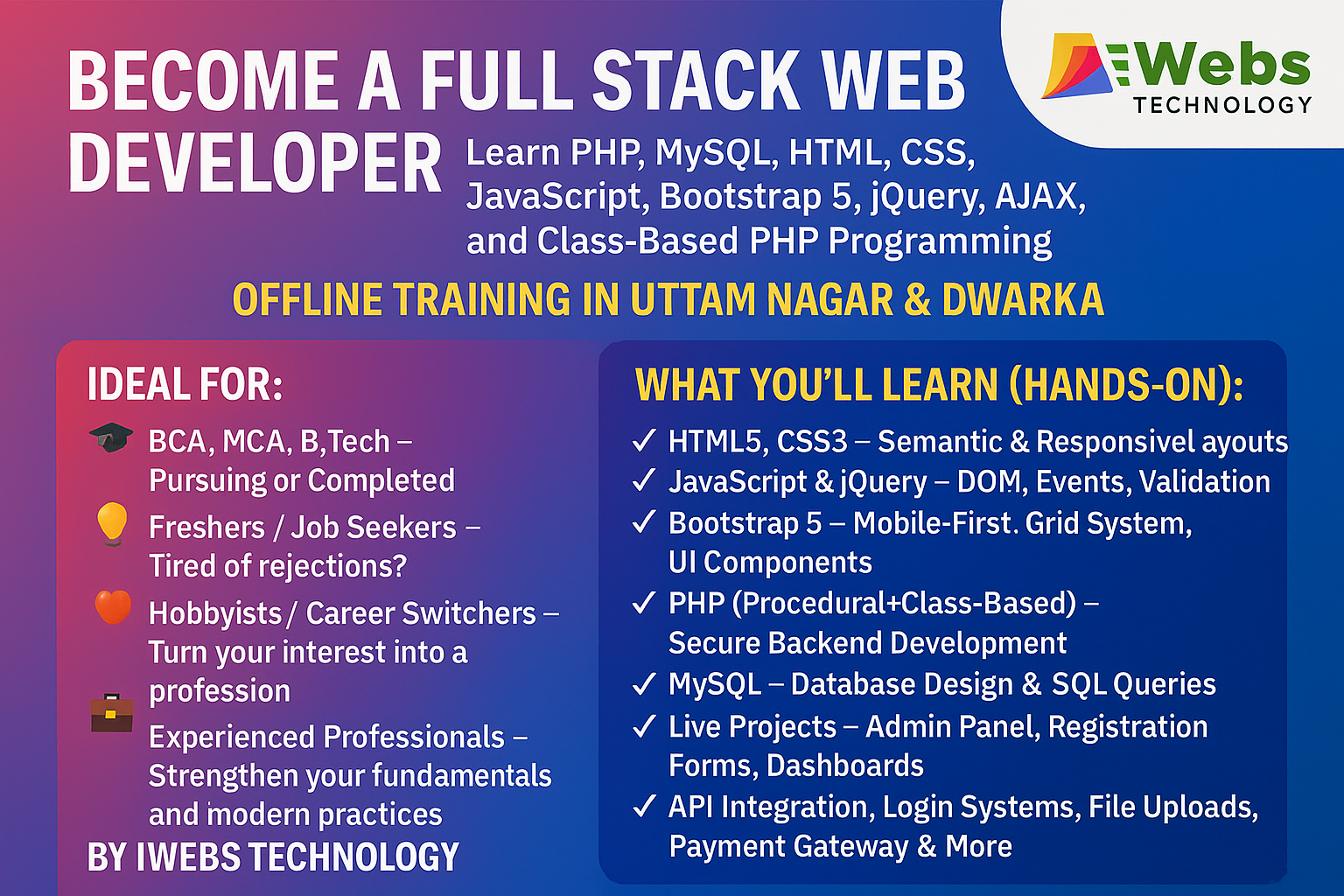
Offline Full Stack Training in Dwarka & Uttam Nagar – Limited Seats!

Join our offline batch in Dwarka or Uttam Nagar and learn full stack development practically.

Struggling in Interviews? Build Skills That Get You Hired!

Facing rejections in job interviews? Build the right skills and project experience.